
Elie Honig on Trust, DOJ and Political Power
CNN’s Elie Honig joins Friday Reporter to explain what makes legal analysis credible, why DOJ’s independence is at risk and what history says comes next.
Elie Honig has spent eight years explaining the Justice Department to CNN's audience in 45-second bursts, and he's done it from a home studio in Metuchen, New Jersey, with an "emergency outfit" hanging nearby in case a scandal breaks mid-dinner. He's also a former federal and state prosecutor and the author of three books, most recently "When You Come at the King," a history of every DOJ investigation into a sitting or former president from Watergate to Trump. We talked about what makes legal commentary trustworthy, why DOJ's independence is more fragile than it's ever been, and what it actually takes to build the kind of career he has. Here's what stood out.
Key Takeaways
Elie Honig says the best legal analysis takes something big and confusing and makes it understandable without dumbing it down — and the worst lets politics or personal preference drive the conclusion.
He argues Trump has pushed the outer boundaries of the law and the presidency further than any predecessor, without being a fascist or a dictator, and says both extremes distort the real story.
His book "When You Come at the King" argues DOJ's independence, a norm dating back to Watergate, has effectively been broken by Trump and needs to be deliberately restored by whoever comes next.
Honig sees direct parallels between prosecuting organized crime and covering political power: the most powerful people are also the most insulated, and accountability usually depends on someone underneath them flipping.
CNN's January 2026 coverage of the Nicolás Maduro arrest, the fatal Minneapolis ICE shootings and the Epstein files gave him three overlapping legal stories to untangle for viewers at once.
His advice to anyone who wants his job: build real expertise first. A law degree and TV ambition aren't enough — you need the courtroom, the newsroom or the deployment behind you before an audience has a reason to listen.
What Makes Legal Analysis on TV Actually Trustworthy?
Honig doesn't hedge on this one. "When I'm doing my job the best is when I'm taking a big, important, but complicated issue and not dumbing it down, but making it understandable," he told me. That means deciding fast how to explain a 48-page indictment in 45 seconds without losing what actually matters in it.
The failure mode, he said, is letting politics steer the conclusion. "There's a certain group that whatever he does is right and fine and legally defensible, and there's another group for whom no matter what Trump does, it's wrong, bad and legally wrong — which is not always the case." He compared it to a financial advisor who always tells you to buy the same stock, or a sports analyst who always picks the same team to cover the spread: predictability is what kills credibility, not the specific opinion.
What Do Prosecuting Organized Crime and Covering Political Power Have in Common?
Honig prosecuted far more organized crime than he's covered, and he says the lessons transfer directly to how he explains political power today. "The most powerful people are also the most insulated people," he said. "There are ways of communicating that are hard to detect from the outside." A mob boss never touches the drugs or shows up at the murder scene — he authorizes it through a narrow chain of underlings, and the only way to reach him is if one of them flips.
That's the throughline of his book "Untouchable," and it's also why his prosecutorial background does real work on air. He compared it to a football analyst who can read a play from inside the huddle rather than just describing what already happened. Few people explaining a search warrant affidavit or a wiretap on cable news have actually drafted one or listened to one live.
Is DOJ's Independence Already Gone?
This is where Honig gets specific rather than alarmist. He rejects comparisons of Trump to historical fascists outright — "the Nazis killed six million Jews, and we're not anywhere near that" — but he's just as clear that Trump has broken a decades-old norm of prosecutorial independence dating back to Watergate. "We've never seen a president who's just come in and said, they're all mine, they're here to do my bidding, they're here to carry out my vendettas," he said.
His book, finished in 2022, predicted Trump would be indicted before it hit shelves and argued the wishful "Trump's going to prison" narrative circulating online was actively counterproductive. He interviewed members of both the Mueller and Jack Smith investigative teams for the book, and both told him the same thing: the prison memes and premature victory laps "gave fuel to the other side" and made their jobs harder. Whoever takes office next, he said, will have to make a deliberate choice about how much of DOJ's independence to hand back — a choice he doesn't think history makes easy, since power rarely returns itself.
Are We Really Heading Into a More Dangerous Political Era?
I asked Honig, a fellow Jersey native, whether the intensity of political and legal scrutiny is genuinely escalating or just feels that way because we're paying closer attention. His answer split the difference deliberately. Trump has posed "serious challenges to the courts, the executive branch and Congress" and done things Honig considers "flagrantly unconstitutional." At the same time, he stopped short of predicting the kind of doomsday scenario some commentators reach for.
What he does expect: whoever follows Trump will govern with less aggressive use of presidential power, not more, because a smart, self-interested president eventually recognizes the benefit of independence — an arm's length from DOJ that protects them as much as it constrains them. How much of that gets restored, he said, will depend entirely on who wins.
What Story From Early 2026 Best Shows Honig's Value to CNN's Coverage?
Honig pointed to a specific stretch: the arrest and indictment of Nicolás Maduro, overlapping with the fatal Minneapolis ICE shootings of Renee Good and Alex Pretti, overlapping again with renewed attention on the Epstein files. Three major legal stories running at once, each requiring a different kind of expertise — international law, use-of-force and policing law, and DOJ investigative process — and Honig said his AG's office background let him move across all three in real time for viewers trying to keep up.
It's a reminder of how much preparation sits behind a segment that looks spontaneous. "For every minute that you see me on air, hours and hours of work and preparation have gone into it," he said, and he's never once read from a teleprompter.
Find Elie Honig
Elie Honig is CNN's senior legal analyst and the author of "Hatchet Man," "Untouchable" and "When You Come at the King: Inside DOJ's Pursuit of the President, From Nixon to Trump." He also teaches at Rutgers, writes weekly for New York Magazine and guest hosts on SiriusXM.
The Friday Reporter is hosted by Lisa Camooso Miller. Listen wherever you get your podcasts — and subscribe so you never miss a conversation.
From Combat to K Street: What Military Strategy Teaches Washington Advocacy
APCIA chief strategy officer Nate Cook, a West Point graduate and former Army Senate liaison, on targeting, key terrain and measuring what works in Washington.
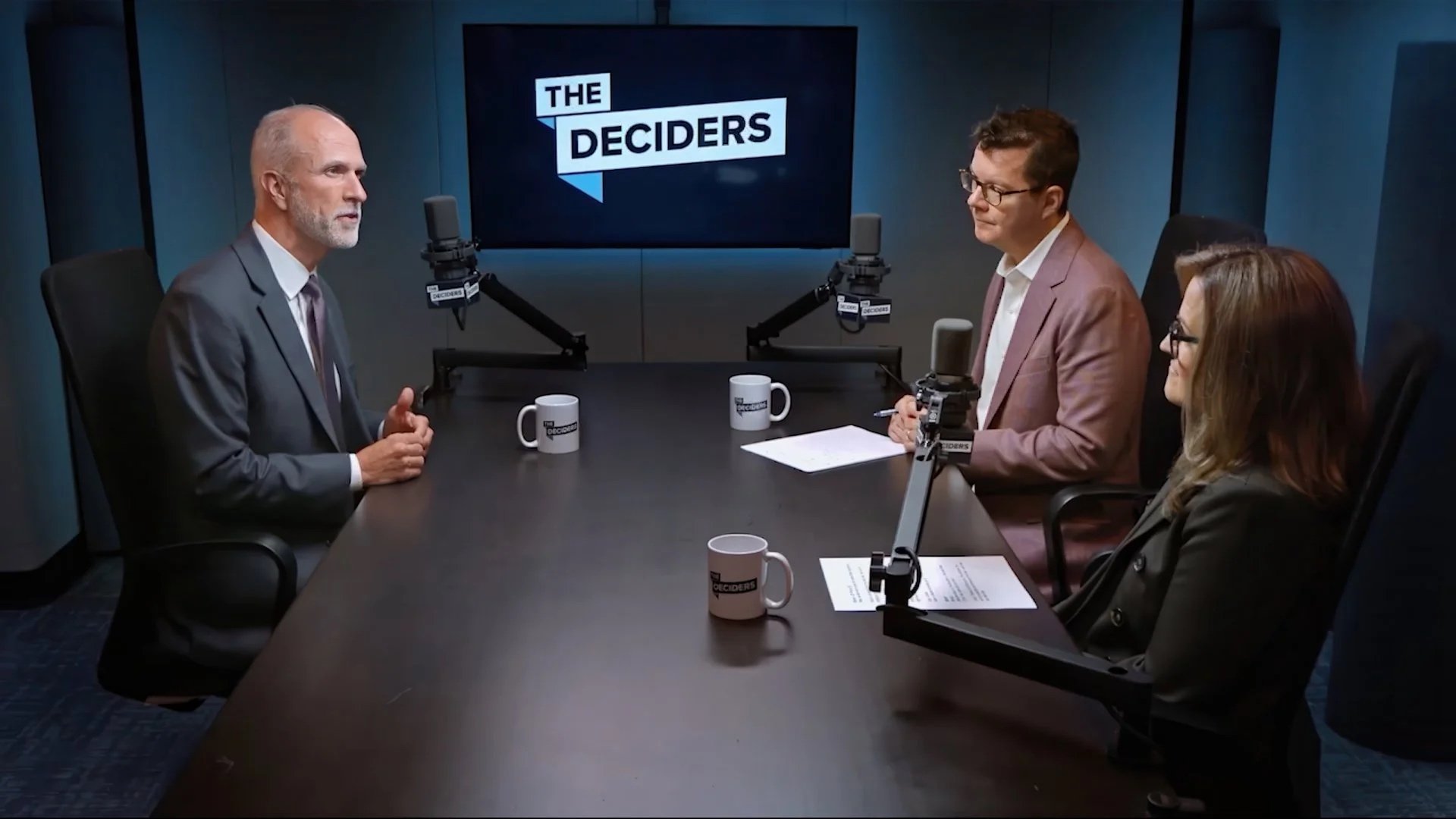
Most trade associations in Washington don't have a chief strategy officer. Very few have one who led soldiers in Iraq. Nate Cook is that rare case, and on this week's episode of The Deciders, Brody Mullins and I asked him what the battlefield taught him about advocacy.
A Career Built on Planning and Execution
Nate grew up in a small town in Texas, the son of a Southern Baptist minister and an educator. Everyone in his family went to Baylor. He went to West Point. He was commissioned as a second lieutenant in field artillery and spent 30 years in uniform, with multiple deployments to Iraq and Afghanistan.
His first Iraq deployment, in 2005, put him in Baghdad as sectarian violence picked up. The mission was to secure Route Irish, the road where more improvised explosive devices were used than almost anywhere in the country. On his second tour, north of Baghdad in Salah ad-Din province, he watched police and security forces improve and communities begin to protect themselves.
He went from leading 20 soldiers to helping oversee brigades of 3,000. The lesson he carried out of it is simple: meet people where they are. Take care of your soldiers and their families in the hard times and the good times, and they'll take care of you.
The Army's Liaison to the Senate
Before leaving the Army, Nate served as its legislative liaison, first to the House and Senate and then to the Senate alone, working out of the Russell Building with personal offices and the Armed Services, Foreign Affairs and Appropriations committees. The Iraq War divided Congress. That isn't what he remembers.
“I never saw something more bipartisan than defense.”
The parties came at solutions from different directions. In his telling, nearly everyone wanted what was best for the country.
How a Soldier Became APCIA's Chief Strategy Officer
After the Army, Nate went back to school in Baylor's organizational change and learning program. A mutual friend connected him with David Sampson, the CEO of the American Property Casualty Insurance Association, who was looking for a chief strategy officer. Nate offered to help him figure out who to hire. Sampson asked why Nate wouldn't take the job himself.
“But you realize I don't know that much about property and casualty insurance. And he said, no, that's okay. I got lots of people who know about that. I'm looking for a fresh perspective.”
Brody called it pulling a Dick Cheney.
Today Nate turns APCIA's five-year strategic objectives into annual work plans and coordinates across federal and state government relations, policy research, international and public affairs.
Targeting, Key Terrain and the Right Resources
The parallel Nate draws between combat and advocacy is targeting. He is careful to say the adversary is different. The method isn't.
“You're looking at where is the key terrain that you want to occupy, so that you can best set conditions for success in the environment where you're operating.”
In practice that means being in the right place at the right time with the right information, whether that's Capitol Hill or a statehouse. And it means measuring. Nate moved APCIA's board reporting from twice a year to quarterly, by strategic objective, with an honest look at what to adjust next. In a town where most bills never become law, that discipline is rarer than it should be.
He's also clear about the environment. Populism in both parties is creating more chaos, and he doesn't think the answer is to fight it. Understand it, show agility and make sure the people making decisions are informed when they make them.
Discipline Without the Drill Sergeant
Nate knew how he might be seen walking in: the military guy here to impose discipline. So he worked to be the person who lightened everyone's load, and he spends much of his time learning who his colleagues are and where their friction points sit. His one do-over is that he moved too slowly in his first 18 months. He'd move faster now.
Trust Has to Be Shown
When I asked about the industry's reputation, Nate didn't start with messaging. He started with showing up: a competitive price, clear coverage and making people whole when disaster strikes.
“That's what builds the reputation and trust, not just telling someone how insurance works or trust me, it's going to be okay. We have to show it.”
What Washington Isn't Talking About
Asked what Washington should be talking about, Nate pointed past AI to what it may bring with it: longer lives and a workforce with seven or eight generations in it instead of four. “It's not that far away.”
Brody's read at the end of the episode: more trade associations and advocacy groups will start hiring people with military backgrounds to run strategy. After this conversation, I'd bet on it.
Watch the full conversation with Nate Cook on YouTube (https://youtu.be/DNZpMNSSiBU) or listen to The Deciders on Apple Podcasts and Spotify.
The Vibes Can Tell You a Lot: What the Ground Game Sees
Echo Canyon Consulting’s Jon Seaton on what canvassing reveals that race ratings miss, why campaigns need to log off and what voters want to hear four weeks out.
Four weeks before an election, Washington refreshes everything. The forecasts. The race ratings. The feed. Jon Seaton gets on a plane.
Jon is the founding partner of Echo Canyon Consulting, the Republican canvassing and direct mail firm named Best New Firm at the 2026 Reed Awards. He ran John McCain’s national field program in 2008 and advised Lindsey Graham. We came up together in Bush world at the RNC — Jon in the field, me on the communications side — and this week he joined me on The Friday Reporter to compare notes on what has changed in campaigns and what never will.
Why Race Ratings Can Miss What the Field Sees
Jon isn’t anti-analytics. He runs a firm that lives on data. But he’s clear about its limits.
“The fact remains that politics is a people business. And there are some things that are just not going to be captured by just raw numbers and polling alone.”
Polling has gotten harder every cycle. Race ratings help set the narrative, but no forecaster can stand in 40 or 50 congressional districts at once, and some of what feeds those ratings is, in Jon’s words, more noise. Everyone in this business has a race that was written off and then wasn’t.
So he pairs the numbers with people: reporters, activists, business owners and families who aren’t thinking about politics at all. He checks Google Trends. He watches the national environment. And he pays attention to momentum.
“When you’re in a district, when you’re in a state, you can really feel when momentum has shifted. They joke about the vibes, but the vibes can tell you a lot.”
For Jon, the data and the vibes aren’t rivals. He uses each one to check the other.
From Clipboards to Phones
On Bush-Cheney ’04 we went door to door with clipboards and paper. Can the president count on your support? Great, here’s a yard sign. If we were lucky we called that voter one more time before Election Day.
What changed everything was Karl Rove’s insistence that grassroots could be measured like money raised or quotes in the paper. Doors knocked. Voters reached. Events attended. Every single day.
“Now it all happens on a phone. You can talk to so many more people. You can learn so much more about them before you ever knock on their door.”
That discipline didn’t stay inside campaigns. Every corporate and issue campaign that works today runs on it, which is why Echo Canyon’s public affairs practice in Phoenix sounds a lot like its campaign shop in Washington.
The Streaming Problem in Campaign Advertising
A campaign Jon worked on a cycle or two ago was spending heavily on television and stuck at a ceiling. So they added one question to a poll: what screens do you watch? Almost half the respondents were getting their entertainment through streaming.
“We could run all the ads we want on cable or even broadcast, and they just weren’t being seen.”
Television is still the howitzer of campaign communications. But the mix has to follow the voter, and the voter is more targetable than ever. Echo Canyon doesn’t knock every door in a precinct or mail the whole voter file. It talks to specific voters about the issues that move them and sends what it learns back to the campaign.
What Voters Actually Want to Hear
Ask Jon what Washington is overweighting this fall and he doesn’t hesitate.
“I don’t know one person in Phoenix, Arizona that cares about what the Kennedy Center is called.”
Voters want to afford groceries and a tank of gas. They want to hear how a candidate will make their family’s life better. Jon took a lesson from John McCain on how to say it: “You can question their judgment. You shouldn’t question their motives.”
The campaigns that miss this are the ones that are entirely too online. They chase the outrage of the day because it feels good — Jon calls it “almost like catnip” — and it doesn’t move a family worried about saving for the future. His fix is blunt. Take Twitter off your phone and listen to voters.
Listen to the Little League Commissioner
The best signal in a district often comes from the local sheriff or the Little League commissioner calling the campaign office to say what they’re hearing. Smart campaigns don’t write that off as one more complaint. They build it into the message.
Jon still remembers a supporter at a victory party that didn’t turn out to be one. She had to take the kids to the school play, she told him, but her husband voted. They kind of needed both votes. Every field operative has a story like that, and it never stops shaping how they work.
On Election Day, Jon sends one tweet: What are you hearing? It’s the same question he asks all fall. The campaigns that win in November are the ones that actually wait for the answer.
Watch the full conversation with Jon Seaton on YouTube [link] or listen to The Friday Reporter on Apple Podcasts and Spotify.
Episode Details
Guest: Jon Seaton, Founding Partner, Echo Canyon Consulting (X: @jonseaton18, @echocanyonUSA)
Host: Lisa Camooso Miller, The Friday Reporter
Recorded: October 2026, four weeks before the midterms
Topics: race ratings and polling, canvassing and direct mail, campaign advertising and streaming, local grassroots, Election Day

Deirdre Walsh on Covering Congress and the STOCK Act
Deirdre Walsh on covering Congress through decades of change—parenting on the beat, Hill camaraderie, and a scoop that rewrote the law.
One minute you're chasing lawmakers through the Capitol; the next you're helping with homework or getting someone off to practice. That's a strange intersection of worlds, and it's one Deirdre Walsh and I have both lived in for a long time. We spent years covering Congress while raising kids, and this week's conversation was about what decades covering Washington teaches you—not just about politics, but about people, priorities, and how your perspective changes over time.
Deirdre and I became friends well before either of us had children, but we really grew up covering and working on Capitol Hill as parents. Today she leads a team at NOTUS—News of the United States—after years as a producer and reporter at CNN and NPR. She is exactly the kind of guest I love having on the show: someone who has watched the institution and the business of journalism transform around her, and who still loves the work as much as she did on day one.
"It changed the issues and the stories I would pitch"
I was curious whether becoming a parent changed the way Deirdre covers Congress, and she didn't hesitate. "I think it changed the issues that I or stories I would pitch as I got older and my kid got older," she told me. She pointed to a stretch at NPR when a group of senators was working on a bill about social media protections. "I was in the throes of battling my teenager about these issues," she said, wanting to know what sites her daughter was on and who was reaching out to her. "I learned a lot about Discord which I didn't know anything about before I had a teenager." What was happening at her kitchen table became a policy story she thought others would relate to.
I feel the same way about the work I do. So much of how we communicate is shaped by what's affecting us at the time. We look at the same institution through different lenses depending on where we are in our own lives—and that's true of life generally, not just journalism.
"Capitol Hill is the best beat by far"
When Deirdre started as a CNN producer around 2006, the team was small—a House producer, a Senate producer, a couple of on-air reporters—and she quickly learned she had to do it all. "I learned that playing as a team was the way to succeed and break news," she said, describing a genuine partnership with the on-air reporters she worked with, the kind who would give you a shout-out when a scoop was yours. "Not all on-air Capitol Hill reporters are like that," she noted. "I felt lucky."
The job itself has changed enormously. There were far fewer reporters on the Hill when she started; now there are digital reporters, broadcasters, newsletter writers, podcasters, and platforms that do all of it at once. "If you're reporting on Capitol Hill, the best way to success is to really think of yourself as a multi-platform reporter," she said, "because the audience is different on different platforms." Still, for all the change, her verdict on the beat hasn't budged: "Capitol Hill is the best beat by far. You have amazing access to newsmakers." You can walk down from the third-floor press galleries into the speaker's hallway and ask a question directly—access most of the press corps shares equally if they hustle to find lawmakers in the hallways.
The collegiality that COVID revealed
One thing that has always stood out to me about the Capitol Hill press corps is how it moves together. There's an exclusive, who's-got-it-first energy, but there's also a ton of collaboration. Deirdre agreed, and COVID crystallized it. Because the Hill—unlike the White House—doesn't have a dedicated pool covering it around the clock, reporters improvised. "During COVID there was an informal pool that was created for reporters that felt comfortable coming to the Hill," she said, while others who couldn't be there transcribed press conferences remotely or helped circulate material. "It was just life-saving."
At NPR at the time, she remembers colleagues who were new moms and didn't feel safe coming in. Deirdre, with an older, vaccinated kid, was up there a bit more than others. The ethic was simple: "If you were there, you helped contribute to the reporting; if you weren't, you helped support those who were up there who did." To her, it was "a testament to that kind of collegiality that's pretty much always been there on the Hill." I couldn't agree more—when I was in the speaker's office, reporters would come up into the communications office to check in on what was unfolding. That give-and-take is real.
The humanity behind the headlines
I asked Deirdre what quality in the members she covers has stayed consistent. "You sort of learn the people that are willing to talk and trust you," she said. "You have to build relationships." There has always been a group of members who, "no matter what time, what phase of my career… were the sort of trusted voices that would not spin you." Those people are harder to find now—"it's a pretty polarized place and with the margin so thin, especially in the House these days"—but she believes they still exist. The fighting she can't romanticize; it's always been there. What's changed is that "the fighting has gone way more public with social media," where it "can be really personal," which she finds an odd way for a lawmaker to operate. Her instinct is to stay out of those fights and talk to people one-on-one.
What would surprise people outside Washington? Some members are friends with people you'd never suspect, and some work quietly on things that get no coverage. She once met a spouse at an off-the-record event who chaired the Congressional Spouses Club and was leading a cancer-prevention initiative—Lisa McGovern, Jim McGovern's wife, working alongside Shelley Moore Capito's husband. Deirdre turned it into a story about research projects and cross-country events, and about relationships built entirely outside of Congress. Then there's the pickleball story: a court in the Dirksen Building where, she reports, Ted Cruz likes to play basketball and Kirsten Gillibrand likes to play tennis, before it gets converted a couple of mornings a week. "It was really fun," she said—and it's the kind of humanity that rarely makes the headlines.
Investing in the next generation—and in a newsroom
Part of what drew Deirdre to NOTUS was its fellowship program. "The fellowship program is just amazing," she said. These are early-career journalists who already have some experience, go through a competitive application process, and then "get jobs for two years with benefits," attend classes, and get sprinkled around the newsroom. She's had two fellows on her team; one just landed a full-time job elsewhere, and a new class is being announced. It sends her back to her own beginnings—giving reporters the same kind of informal training she got, telling them which of the 435 House members and 100 senators are good talkers and which will blow you off. "I want them to be Hill nerds," she said. "I want them to love it as much as I do."
That reinvestment is, to me, one of the few hopeful stories in journalism right now. Deirdre previewed more of it: local reporters covering a contested D.C. mayor's race, sports reporters on the Nationals and "the intersection of power and sports and politics," and coverage of the business of the city itself, not just the government. As someone who moved to Washington to cover Congress and now calls it home, she sees NOTUS building something a little different from the other outlets in town.
The scoop that made Congress change the law
Every journalist dreams of doing work that actually moves the institution. Deirdre has. Around 2012, Congress was debating the STOCK Act—the Stop Trading on Congressional Knowledge Act—after a bad run of stories suggesting members were profiting from information gathered on the job. After it passed, a source mentioned that the rules were being applied differently in the House and Senate. "How can that be? They passed the same bill," she remembered thinking. "That sounds like a loophole." It was: one chamber wasn't covering spouses or dependent children, meaning a family member could trade without ever disclosing it. Working with her longtime reporting partner Dana Bash, she confirmed it. "A couple days later I got this phone call," she said—watch the House floor. They "basically closed the loophole and changed the law because of our story." The broader debate over members trading stock is still alive today, but she was there at the very beginning. "You always dream of making Congress do something to react to your reporting."
For my last question, I asked how she balances it all—the career, the family, the mess of it. Her honest answer was that there's no perfect advice, but the lesson from her very first job, as a researcher for Judy Woodruff, has carried her: preparation. "Read up and be ready to know what questions you want to ask… be prepared when you go in and start reporting on a story." Being prepared is how she knows she's done all the work she can. "I can't control what happens next, because this is a crazy news cycle every day, but at least I can know that I've done what I can to get ready for the day—and then you just have to go and adjust along the way." That's good advice for any career.
Key Takeaways
- Becoming a parent reshaped which stories Deirdre pursued — including a social media protection bill she covered while navigating the same issues with her own teenager.
- Capitol Hill's press corps proved unusually collegial during COVID, running an informal reporter pool since the Hill, unlike the White House, has no dedicated press pool of its own.
- Success on today's Capitol Hill beat requires thinking like a multi-platform reporter — digital, broadcast, newsletter and podcast audiences all expect something different.
- Her and Dana Bash's reporting exposed a loophole in the STOCK Act that let lawmakers' spouses and dependents trade without disclosure — Congress closed it directly in response to their story.
- Her core rule for handling an unpredictable news cycle: you can't control what happens next, only how prepared you are before it does.
Find Deirdre Walsh
Deirdre Walsh is a veteran congressional journalist who has covered Capitol Hill since around 2006, with reporting and producing roles at CNN and NPR before joining NOTUS (News of the United States), where she now leads a team covering Congress, the White House, and Washington. You can follow her reporting and her team's work—politics, local coverage, and the business of power—at NOTUS.
The Friday Reporter is hosted by Lisa Camooso Miller. Listen wherever you get your podcasts — and subscribe so you never miss a conversation.

Bruce Mehlman on the Age of Disruption and AI Advice
Bruce Mehlman on the Age of Disruption—why nothing is unprecedented, why what you do beats what you say, and how to counsel kids on AI.
Everyone I know seeks out Bruce Mehlman for counsel at the intersection of technology, policy, and politics. For years he distilled that thinking into big quarterly slide decks; now he does it every week in a Substack he calls The Age of Disruption. This conversation was about how the three chapters of his career—government, technology, and consulting—come together into a point of view that reporters, executives, and even Sunday-show hosts keep borrowing from.
Bruce is a partner at Mehlman Consulting, a bipartisan government-relations firm, and a former technology-policy official at the U.S. Department of Commerce, where he and I first crossed paths two decades ago. He's a self-described nerd who loves history, politics, and policy—and who has a rare gift for making the present moment feel legible rather than terrifying. I think you're really going to like this one.
"Microsoft flagged me as a spammer"
The origin of the weekly newsletter is one of my favorite small stories. For years Bruce produced giant quarterly decks—30 or 40 slides, "sort of Mary Meeker meets Karl Rove"—that he loved making and that drew real feedback from people he respected. But his distribution method was gloriously inefficient: an enormous spreadsheet of names, sorted by company and VIP status, blasted out 40 people at a time in BCC. One day it all jammed. "Microsoft concludes that anybody who sends that many BCC identical emails out in that short a period of time is sort of definitionally a spammer," his IT team told him. That forced him onto Substack—which he likes reading and finds easy to use—with one catch: "You got to feed the beast more than once a quarter." A couple of thematic posts got that dopamine hit of shares and new subscribers, and suddenly he was a weekly writer. The trade-off is real; the free Sunday-morning post takes him "somewhere between three and eight hours," time carved out of sleep, family, and client work. But it cuts through—he watched a Sunday show pick it up—and people reference it constantly.
20th-century institutions, 21st-century problems
Ask Bruce for the day in the life and you get something much bigger: a theory of the moment. "We're living through an extraordinary time in American history," he said, "not unprecedented. We go through periods like this." His frame is a mismatch between the institutions we inherited and the problems we actually face. "In this case, 20th-century solutions to 20th-century problems"—policies and institutions built in a prior era that are no longer well-designed for the new one. He reached for history: the New Deal answers that no longer fit the "malaise, sclerotic economy" of 1970s America and set up the Reagan Revolution; the agrarian rules of the late 1800s that couldn't handle the Industrial Revolution and gave way to the Gilded Age and then the Progressive Era. "We're living through, I think, another mismatch," he said—people in the real world facing 21st-century challenges and concluding, "these guys don't get it. They're not solving my problems." The trade deals look good for people in Davos but not for me; that's why the factory moved to China. "You know what I'm going to do? I'm going to vote for change." That, he argues, is what connects the macro trends to the everyday politics we all feel.
Technology's fading halo
When Bruce and I first worked together, technology had a halo. He walked me through how it slipped. Internet 1.0 was "awesome"—until the stocks blew up and everyone decided buying dog food online was stupid, "the right idea at the wrong time." But the internet and late-'90s America were seen as net-positive answers: new voices got channels, there was hope, and, as he joked about early online privacy, "nobody knew you were a dog." Two things changed. Technology became ubiquitous, defining every aspect of modern life "overwhelmingly to the better." But it moved from "less impact on our lives and a lot of promise to overwhelming impact on our lives and a mixed picture." His example was perfect: the app that lets him order the same coffee at the same red light and just show up to grab it. "The good news is, my God, that's efficient. The bad news is I used to know the baristas." Now the upsides are magnified—and so are the downsides, from disinformation to teens weighed down by FOMO.
The Vertigo Years: nothing is unprecedented
Bruce's antidote to feeling like the world is moving too fast is history—specifically Philip Blom's book The Vertigo Years, about the world just before World War I. Back then, just like now, "how we work, live, play, learn, parent, fight wars" was overwhelmingly transformed by technology. "Today we know it's the internet, it's autonomy, it's drones, it's AI. But back then it was electricity," along with new manufacturing, automobiles, airplanes, telegraphy, and telephony. People reported nervous disorders; they couldn't keep up. "It reminds me that nothing is unprecedented if you've read history," he said. And he's optimistic about where it goes. In 20 or 25 years, he expects home assistants that have become part robot and far more thoughtful—"you'll just say what you want and it'll do so many of the things"—and we won't say this sucks. "It won't have drained humanity out of being human. We'll just be spending our time doing other different cool things." I told him I say a version of that to my own kids all the time: remind yourself of the pivot points in history, and you remember we've seen change before.
What you do matters more than what you say
Because Bruce advises companies on political risk, I asked what counsel he gives now. He started with what lobbying firms do at their heart: help organizations "understand what's going on, separate headlines from reality, anticipate what's likely to happen next, and engage" the right policymakers and stakeholders. So much of it is understanding risk—war, supply chains dependent on Taiwan or mainland China, tariffs, climate, technology. And in the social-media decade, brands got dragged into contact with activists in a new way, where an online boycott could change a company's behavior "not because of a law, but because of the perceived reputational risk"—first from the left, later from the right. Businesses now face not just supply-chain and geopolitical risk but "the culture-war risk of getting dragged into one side or another of a 50-50 issue."
His answer is a piece he once wrote, "Woke Capitalism and Its Discontents," and he's careful to be balanced—"my firm is half Republican, half Democrat." Two camps are both wrong, he argues: those who think a business should never speak about anything (they miss that silence is itself a position) and those who think a company needs a "secretary of state" opining on every news event ("that's an insanely horrible policy"). His north star is simple: "What you do matters more than what you say." If your young employees care about climate, don't become their Twitter spokesperson—look at your supply chain and make it more sustainable; write the checks; expand first-generation college access. "I don't care that you have 100% approval rating from the American Conservative Union or the ACLU. You're just a bunch of hot air. I want to see what you do." He illustrated it with a story about his old law-school roommate, Andy Keys, who quietly bought Christmas trees and left them for families who needed them, never telling anyone. "That's so much more powerful than somebody trying to get credit." His advice for businesses and careers alike: "Do the right thing. Don't worry about whether it's adequately heralded." Or, as the line taped to his wall puts it, "No grind, no glory."
Counseling the next generation on AI
I told Bruce about my own 20-year-old, who came home wondering whether he should go to trade school because AI felt like a threat to future jobs. Bruce, who has three kids in their twenties and teaches as well, called AI "unbelievably scary and unbelievably empowering." He rejects the idea that blue-collar work is safe while creative work is exposed: "Blue-collar jobs aren't safe from AI"—the robots can't do the plumbing or the welding yet, "but they will." His solution isn't fear, it's fluency: "Learn more about AI, learn how to use AI." He wants people who can be the best in the office at "prompt jockeying"—knowing when to reach for Claude, when for ChatGPT, when Gemini gets the best answer. But he's disciplined about verification, especially for client work and his own writing: if he sent an LLM's wrong answer to a client, "they should fire me," because his job is to give the right answer. Used well, though, it saves him an hour of hunting for sources. His analogy is the one that should reassure my son: "The internet didn't get rid of jobs. It enhanced all of our jobs." The people who win are the ones who learn to leverage the new tools first. He even sees a future where 3D printing collapses supply chains and "Nike is just a design company now," printing shoes fit to your feet in 20 minutes.
Key Takeaways
- History says nothing today is truly unprecedented — Mehlman points to the New Deal era and the Gilded Age as past examples of institutions failing to fit new problems, just as they are now.
- His rule for corporate political risk: "what you do matters more than what you say" — action, not public statements, is what actually manages reputational exposure.
- Technology's impact has shifted from "low impact, high promise" in the early internet era to "high impact, mixed picture" today — magnifying both the upsides and downsides.
- On AI, his advice is fluency over fear: learn to use the tools, but stay disciplined about verifying anything before it goes to a client.
- No job is fully insulated from AI, in his view, including blue-collar work — but he compares it to the internet, which reshaped jobs rather than eliminating them.
Find Bruce Mehlman
Bruce Mehlman is a partner at Mehlman Consulting, a bipartisan government-relations firm in Washington, and a former technology-policy official at the U.S. Department of Commerce whose career has spanned government, Silicon Valley, and consulting. He writes the weekly Substack The Age of Disruption. The easiest way to find it, in his words: Google "Bruce Mehlman" (M-E-H-L-M-A-N) and the word Substack, and you'll land right on it. You can also connect with him on LinkedIn.
The Friday Reporter is hosted by Lisa Camooso Miller. Listen wherever you get your podcasts — and subscribe so you never miss a conversation.

Colin Demarest on the Iran Conflict and Drone Warfare
Axios's Colin Demarest on the Iran conflict, drone reality vs. hype, whether the defense industrial base can sustain a long fight.
For years, the Pentagon talked about drone dominance as a strategy: hundreds of thousands of expendable drones, a military that could outpace and overwhelm any adversary, the factory as the weapon. Then Iran shot down an American fighter jet, and we stopped talking about strategy and started watching it get tested in real time—with results more complicated than any briefing slide suggested.
My guest this week has been covering the future of defense long enough to know the distance between what the Pentagon says and what's actually happening on the battlefield. Colin Demarest authors Axios's Future of Defense newsletter and has been deep inside the Iran conflict coverage since the first strike. He's watched brand-new weapon systems get their first real-world test, tracked the costs as they climb, and kept asking the harder question underneath all of it: whether the defense industrial base that built those weapons can sustain a long fight.
"Almost everything" has been a surprise
I opened by asking what has surprised him so far. "Almost everything," he said. "I think everyone is surprised about a lot, honestly." New weapons, new software, new hardware. Some people expected the conflict to be in-and-out—"dust your hands, we're good here"—and were surprised by its length. Others weren't surprised at all. The number that sticks with him came from Pew Research: roughly 54% of U.S. adults think the conflict will run another six months. "Maybe that number is what's surprising me so much," he said. "Like half of America thinks we're in this for a very long haul."
Drone reality versus the briefing slide
We got specific about the new systems. The PRSM—"Prism"—missile is, as he put it, "probably a very sensitive, controversial one" after outlets including the New York Times and the BBC reported it struck a school and a sports hall in Iran, a claim CENTCOM disputed and the BBC pushed back on. He was careful not to overstate what he doesn't know. The LUCAS drones he had more of a read on: "Admiral Brad Cooper has said they're indispensable." What makes them fascinating is their origin story—they are Iranian Shahed drones "basically taken back to America, re-engineered, maybe boosted, maybe improved a little bit, stamped with Made in America and then sent back overseas," and from a small company, not a Lockheed or a Northrop.
Then there's the phrase he wrote that stuck with me—"the factory is the weapon"—now colliding with the reality of a U.S. fighter jet going down. Colin pushed back gently on drawing too neat a line. Production is the hot conversation right now, from interceptor stockpiles to offensive and defensive missiles to drones, but "I don't know if you can put the drone and the F-15E Strike Eagle in the same category." He recalled Elon Musk tweeting that FPV quadcopters would replace the F-35: "And that's just nonsense. One can't do the other." The real work, he argued, is "finding the right balance, finding what you need to produce more of, less of, quicker, slower." And he offered a warning worth repeating: "If anyone tells you they know the exact algorithm and the exact quantities of everything that we need, they're lying or they're trying to sell you something."
What the New Jersey drone panic actually revealed
I couldn't have Colin on—both of us from New Jersey, along with my production company—without asking about the drones over the Garden State. He laughed; his mom still sends him photos of the sky. "I don't think it was aliens above New Jersey," he said. "They could go way cooler places than like Newark Airport." His read is that a lot of people suddenly became aware of something and "had never really maybe looked up at the sky before." But the serious point underneath the jokes is a real one. He wrote that the episode "exposed just how bad the plans are for suburban America," and he connected it to genuine vulnerability: "That has real implications for like the World Cup or the Super Bowl." Awareness, in other words, cuts both ways.
Can the industrial base sustain a long fight?
The number that keeps surfacing in Colin's reporting is the cost of the conflict—north of $16 billion and climbing. So I asked the question at the center of his beat: is the defense industrial base actually built to sustain a long fight, or have we been planning for a war we expected to win quickly? He laid out both sides. Those who want to re-industrialize America will tell you the base isn't built for a sustained conflict like Russia-Ukraine. But there's another argument: "We don't have a procurement issue, we have an appropriation issue." Sure, we could make more missiles, "but where's that money coming from? We can't even pass a budget." The Lockheeds and Northrops can build more factories, "but they need the money and the commitment from the Pentagon," and standing up a new bomb factory isn't casual—"that takes a lot of work and a lot of planning and just a lot of commitment all around."
How a guy from New Jersey got this beat
"By pure accident," Colin said when I asked how he landed here. He went to school in South Carolina for journalism and photography, wanted to do politics, and got his first paid byline covering Trump in the 2016 primaries—at a barn, with squash and broccoli as the backdrop. ("I have the photo. I'm not making this up.") Back in South Carolina, about twenty minutes from his newsroom sat the Savannah River Site, a Department of Energy/NNSA facility known for tritium production, aging radioactive-waste tanks, and eventually plutonium pits for warheads—and nobody was writing about it at length. His editors let him explore it, and he spent four and a half years on nuclear weapons policy, production, and cleanup. "That is my favorite beat," he said. "The consequences of that conversation are potentially world-ending, and that's what makes it so grave and exciting." From there he was scooped up by Defense News and Military Times and C4ISRNET—"I say I covered everything you couldn't see"—before Axios called and asked if he wanted to write about the future. "I was like, sure, let's do it."
He's clearly found his home. "The defense and Pentagon press corps is incredible," he told me, describing conferences and travel spent together. He has deep respect for local news as "the most important kind of bastion of newsmaking," even as he admits he doesn't want to go back to covering the planning commission. His pitch for the intensity of his beat is one of my favorite lines of the conversation: "If you think you've ever seen people worked up at a political rally, you've never been to a zoning board appeal."
Access, rhetoric, and where the information really lives
We talked about the Pentagon's recent moves to change media access. Colin, who used to be in the building once or twice a week, was measured. Turning in the badge and declining to sign the new paperwork "wasn't like the biggest blow to my reporting"—he does his job from home just fine. He acknowledged the larger concerns about press freedom, including a plan to shutter the correspondents' corridor and move reporters to some undisclosed annex. But his core prediction was firm: "I don't think locking out journalists or booting journalists from a building will keep them from reporting. If anything, I think it will backfire and have more people leak." As I put it, tell someone not to go in the room and they'll want to look in the room. "Absolutely," he said.
That led us to the gap he covers best: the space between what officials say and what happens. After the Defense Secretary claimed the U.S. had achieved dominance over Iranian skies—just before a jet went down—how does he read that? He was careful about the technical definitions of "superiority" versus "dominance," which he didn't want to botch, but the larger point was clear: "There is definitely a gap between rhetoric and what's happening on the ground or in the skies." His rule of thumb: "You only need one percent for something to go wrong," so "I would take anyone's comments about being bulletproof with a grain of salt." He also sees the center of gravity for information shifting. "Most inquiries made get referred to the White House," he said—even questions to the Navy about a Navy ship. "It's your ship. Why do I have to ask the White House about it? And you can read into that what you would like."
The "megadecade" and what he's chasing next
Colin has called this a "megadecade" for defense, and three months into the Iran conflict he stands by it: the Davidson window and Taiwan, the rise of China and its nuclear arsenal, an ongoing Russia-Ukraine war, and now Iran offering a read into what a modern U.S. war looks like. "Sure, it might be a little bit of marketing, but I think it's still a good read." He broke the story that the U.S. passed on Ukraine's offer to share battle-proven anti-drone technology before the conflict—crediting colleagues who led it—and he's genuinely curious about the willingness to actually learn lessons from Ukraine "versus just talking about them," knowing those lessons still have to get into budgets and doctrine. The larger Russia-Ukraine question, he expects, "will take a long time to digest."
As for what he's chasing right now, the honest answer is that it changes by the hour. On the day we talked, he was watching NATO Secretary General Mark Rutte come to Washington to mend fences with President Trump—who had just called NATO a "paper tiger" from the White House podium. "I'm fascinated by what's going to happen behind closed doors there." The pace, he admits, is addicting. As his colleague likes to say, "you have to be a little sick in the head to do this nonstop." It's a breakneck pace, "and you just got to keep your head on straight."
Key Takeaways
- Roughly 54% of U.S. adults expect the Iran conflict to continue for another six months, per Pew Research — longer than many initially assumed.
- The LUCAS drone program repurposes captured Iranian Shahed drones, re-engineered and redeployed by a small U.S. company, not a major defense contractor.
- Demarest frames the sustainability question as an appropriations problem, not a production problem: "we don't have a procurement issue, we have an appropriation issue."
- The conflict's cost has already topped $16 billion and continues climbing.
- He predicts restricting Pentagon press access will increase leaks rather than reduce reporting: "it will backfire and have more people leak."
Find Colin Demarest
Colin Demarest is a defense reporter at Axios, where he writes the Future of Defense newsletter—covering the Pentagon, the defense industrial base, drones, nuclear policy, and the technologies shaping national security. Before Axios, he reported for Defense News, Military Times, and C4ISRNET, and spent years covering nuclear weapons at the Savannah River Site. His newsletter goes out every Wednesday and you can subscribe on the Axios website; he also helps lead Axios's defense events, including the annual Future Defense Summit.
The Friday Reporter is hosted by Lisa Camooso Miller. Listen wherever you get your podcasts — and subscribe so you never miss a conversation.
The Firm That Said, “No.”
A conversation with CGCN Group's Mike Catanzaro on turning down private equity money, staying independent and building a lobbying firm that survives any administration.
The K Street Firm That Keeps Saying No to Private Equity
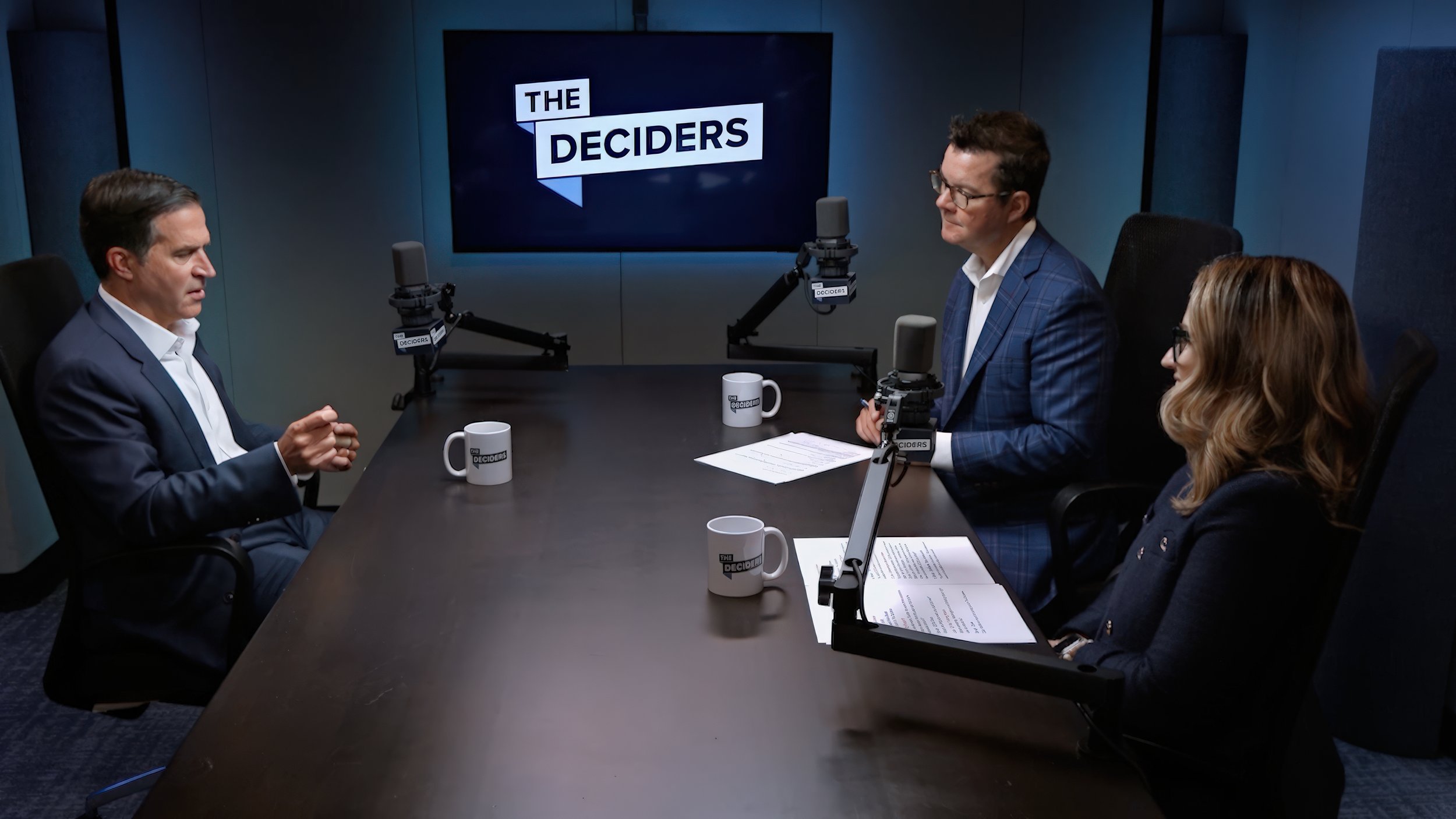
Mike Catanzaro told Brody and me something on The Deciders this week that most CEOs in this town would never say on the record — not “we’ll consider it” and not “we’re staying flexible.” Just plain, no.
The Private Equity Problem on K Street
Private equity firms have been circling Washington lobbying shops for years, offering cash for growth and an exit for founders. CGCN Group, the Republican firm Catanzaro co-founded, keeps turning them down.
"We don’t want them to be our bosses. We don’t want people telling us how to run our business."
In this week’s episode, Catanzaro talks independence like a business decision.
His firm considered going bipartisan once, right after a brutal 2020 election, when plenty of Republican shops were quietly building out Democratic practices as insurance. CGCN said no to that, too.
What Trust Actually Buys You
"We’ve cornered the market on the best Republican information analysis in Washington because of that trust. If we go bipartisan, we lose it."
He was pleased to report that CGCN grew during the Biden years. Not despite being an all-Republican shop, but because of it. Clients needed help fighting regulations they hated and CGCN had built the muscle to do exactly that.
"We positioned the firm to be immune to what we once thought were adverse political cycles. For us, it doesn’t matter."
Most of Washington optimizes for the next election, not the next decade. Hedge the bet, diversify the client list, take the money when it’s offered because who knows what happens eighteen months from now.
That instinct makes sense, but it’s a different bet than the one Catanzaro made.
The Novak Rule
He learned to make it from Bob Novak — the columnist he worked for as a young reporter, decades before any of this. Novak’s rule was sit down, shut up and listen.
"No one cares what you think or what you say."
Everyone in this town wants to be the smartest person in the room. Novak taught a 20-something that the room doesn’t need him to be smart. It needs him to be paying attention.
I think that’s the thread running through all of this. The private equity offers. The decision to stay Republican. The way the firm grew during the Biden years.
Catanzaro built a firm that doesn’t need to know what happens next, it just needs to pay attention.
The Deciders with Mike Catanzaro hits YouTube tomorrow morning. https://www.youtube.com/@DecidersShow

Dan Clifton: Washington Is Wall Street's New Center
Dan Clifton on Why Washington Is the New Financial Center: The Lobbying Index, the Coming Tax-Refund Tsunami, and Reading Political Risk
For most of my career, Wall Street and Washington operated like two cities that didn't quite speak the same language. Today, what happens in one increasingly decides what happens in the other—and almost no one translates between them as well as Dan Clifton.
Dan and I have been friends for more than twenty years, going back to New Jersey politics. He's a partner and head of policy research at Strategas, a job that has him up before dawn helping investors, executives, and even policymakers understand what Washington is about to do and what it will mean for the economy. He's a sought-after voice on CNBC, and every single time I spend time with him, I walk away smarter. This conversation was no exception.
From loading buses in New Jersey to the top of the governor's office
Dan's path started at Rutgers in the mid-1990s, working part-time at a housing finance agency in Trenton and getting pulled into Republican politics while Christie Whitman was governor. He organized Rutgers students for the governor's reelection, and he tells the origin story as a mix of preparation and luck. Worried there wouldn't be enough people at the buses on Election Day—the kind of empty-parking-lot image that becomes the story of the day—he pushed senior campaign officials hard. It turned out to be overflow capacity, and his team's county reported last and put the governor over the top.
From there he moved fast. "I went from loading up college students in 1997 to working for the governor's chief of staff by 2001," he said—"one cycle from bottom to the top." He worked across New Jersey government, including the Port Authority of New York and New Jersey and the Casino Reinvestment Development Authority, before moving to Washington in 2002 to work on tax policy during the Bush tax cuts. A friendship with Larry Kudlow eventually led to a startup research firm asking him to run its Washington office. That was nineteen years ago. The firm has grown from a small startup into a successful one with roughly 60 employees and clients in dozens of countries. "It's been a good ride."
"Washington as the new financial center"
What Dan's team does is deceptively simple to describe and enormously hard to do: figure out what Washington—the White House, Congress, the regulatory agencies, the Federal Reserve—is going to do, and how it will hit financial markets and the economy. "Partisan politics are out the door," he told me. "We don't have the luxury of choosing one side or one issue. We just got to know what's likely going to happen and what the impact of that's going to be."
When he got into the business, he was, in his words, the lowest guy on the totem pole in 2007. Then the financial crisis hit and Washington's grip on the markets tightened dramatically. "We used to joke, like, Washington as the new financial center," he said. "And that tends to be the case today." He backs it up with a striking data point: in 2008, about 25% of companies named Washington as their largest risk in SEC filings—mostly government-dependent healthcare, defense, and utility companies. A decade later, "more than half of the S&P 500 was saying that Washington is their greater risk," and roughly 75% put it in their top two. His job is to cut through the noise "and say this is what's important at the end of the day."
The team that punches above its weight
Dan is relentlessly generous about the people around him, and his Washington team—around sixteen people who, as I told him, punch above their weight every day—is the engine. He walked me through the three colleagues on the other side of his wall. Chris McGrath, an intern back in 2017, understands the Treasury and Federal Reserve "plumbing of the entire financial system probably better than most people in the government right now." (McGrath was also drafted into Major League Baseball; Dan likes to say he's "a better data analyst than he was a pitcher.") Courtney Gellman takes what's happening in Washington and figures out which companies will be affected, building the investment implication—because, as Dan puts it, simply reporting what's happening in Washington is "no different than what you could see on TV or read in the newspaper." Jeanette Lowe lives inside the legislation, where the quirks and nuances hide. "No one individual can do this all on their own," he said. After nineteen years, it's still a team effort—and it gets better every day.
The $150 billion tax-refund tsunami no one is pricing in
The most useful thing Dan does is spot the thing Washington and Wall Street are both underappreciating. Right now, that's the design of the major tax legislation passed last summer—the "one big, beautiful bill." There were two ways to deliver the relief, he explained. You could lower the income tax rate and adjust withholding so "every American would get a raise right away," almost immediately blunting the drag from tariffs. Instead, the relief is coming through refunds tied to the state-and-local deduction, the child credit, and no tax on tips. The result: "a tsunami of tax refunds that are going to come out in February, March and April." He puts the delta at about $150 billion—"about a half a percent of GDP"—potentially the largest tax-refund distribution as a share of the economy outside of COVID.
The political consequence is that voters aren't feeling any benefit yet. "Americans are worried about affordability. They're not getting any credit for one big, beautiful bill because nobody's felt it yet," he said. "And that was really a design issue." His team's value is laying out option one, two, and three, and then modeling exactly who gets those refunds and when—an effect he says is underappreciated on Wall Street and even less understood in Washington. As he put it: voters are relentless—"what have you done for me lately?"—and the refunds don't land until well before, but not right up against, the midterms.
The lobbying index: measuring who has a seat at the table
The heart of our conversation was a tool Dan built that more people in Washington should understand: the lobbying index. "It basically quantifies the impact of government affairs on companies' earnings," he explained—a way for a corporate lobbyist to go back to headquarters and show the value they create. But that's not why he built it. After Bear Stearns collapsed in March 2008, his team spent that summer testing whether political variables historically moved stocks. "Everything failed," he said—PAC funding, individual companies, none of it worked. "And then we hit gold." Lobbying, measured not in raw dollars but relative to a company's size, was statistically significant across the top 50 companies and clearly affecting stock performance. Companies dedicating resources to government affairs were earning an outsized return in the equity market.
He was cautious—in investing, backtests always work until real life proves them wrong—but the results held. In 2008 the equity market fell 40%; his lobbying index fell 28%. "To get a 12% spread is really an enormous difference." When he went public with it in early 2009, as the pitchforks came out over who caused the crisis, his pitch was blunt: "These are the companies that have a seat at the table. If the pitchforks come out, maybe they'll have some level of protection." The basket outperformed year after year from 2009 through 2017. He's since broadened it to small and mid-size companies, to non-U.S. firms that lobby in Washington ("that's where we get the most outperformance"), and to specific themes like defense technology.
The point isn't cynical, he insists. "Companies are making an investment in Washington like they would for research and development, with the idea that they're going to get some sort of return," and the market doesn't know how to price it. He pointed to Vertex Pharmaceuticals, whose cystic-fibrosis work he calls revolutionary, and to Hyundai Electric—one of the fund's largest holdings—whose power-generation business sits at the center of Washington's scramble to power AI. For anyone who wants to look deeper, the strategy runs through the firm's asset-management business in the Strategas Global Policy Opportunities Fund (SAGP). "Lobbying gets a bad name," he said, "but the good that it does is much greater than any of the negative."
Why policy uncertainty is the new normal—and what he's watching
Even companies that don't lobby, Dan argues, need "an ear to the ground." He cited economists who measure policy uncertainty and hit the highest level ever recorded this past April, when tariffs affected every company's supply chain. The firms paying attention understood what was coming and how to work around it—no special treatment, just awareness. And counterintuitively, he doesn't see uncertainty as all bad: "It creates this environment where it gets fixed if it's too bad."
The bigger frame is that we're at the end of an era. "We've just gone through a 30-, 35-year period where the Berlin Wall went down, the world globalized, inflation was low, interest rates were low, political volatility was low. And that period is basically coming to an end." What replaces it, he expects, is deglobalization, slightly higher inflation and interest rates, and more geopolitical volatility—no matter which party is setting the speed. "It's not bearish. It just requires an adjustment. And those who figure out that we're adjusting are going to be the winners." (He's also holding out hope the '80s comeback delivers another Rocky IV or Top Gun.)
As for what he's watching next: a rare, deep split at the Federal Reserve over whether tariffs are stoking inflation or slowing growth; the implementation of the tax bill, including roughly $135 billion for companies to write down factories and R&D to encourage onshoring; electricity costs, which he saw drive recent elections and may push Congress to act before the midterms; housing and mortgage rates locking young people out; and a looming Supreme Court ruling on tariffs. On that last one, "we think that Trump has a full replacement plan that's legal" and would move quickly—but the ruling itself "will be a big news story." And then there's keeping the government open at the end of January. "No shortage of topics."
What keeps him going
For all the intensity, Dan is grounded by family—a wife and two kids, nine and five—and by baseball. His investment themes even track it: he sees a younger, larger family cohort moving into youth sports and, eventually, driving demand for professional sports. But the deeper reason is bigger than markets. Sports, he told me, is "the one thing that unifies our country at a time when we're being divided almost more so almost every single day." He went off X for six months and came back convinced: "There's a lot more that unifies us than divides us." I'll take that—and, as fellow fans, we agreed on the sign-off: let's go Yankees.
Before we wrapped, I asked Dan who I should talk to next. He nominated two people who play the government-affairs game well: Scott LaGanga from the pharmaceutical world, and Nadia Paps, an energy lobbyist—especially given how much electricity and affordability will shape 2026. They're both on the list, and I told him he gets the credit.
Key Takeaways
- Washington has become "the new financial center" — more than half of S&P 500 companies now name it as their top business risk, up from about a quarter in 2008.
- Clifton's lobbying index shows companies that invest in government affairs, relative to their size, have historically outperformed the broader market.
- A roughly $150 billion wave of tax refunds tied to this summer's tax bill is set to hit taxpayers in February through April — one of the largest refund distributions as a share of GDP outside of COVID.
- He frames current policy uncertainty as self-correcting rather than purely negative: "it creates this environment where it gets fixed if it's too bad."
- Key items on his watch list heading into 2026: a Federal Reserve split over tariffs and inflation, a pending Supreme Court tariff ruling, and electricity costs shaping congressional action before the midterms.
Find Dan Clifton
Dan Clifton is a partner and head of policy research at Strategas, where for nineteen years he has helped investors, executives, and policymakers understand how Washington's decisions move markets and the economy. He's a regular voice on CNBC. To learn more about his team's work and the lobbying index, look up Strategas asset management and the Strategas Global Policy Opportunities Fund (SAGP)—or reach out to Dan directly.
The Friday Reporter is hosted by Lisa Camooso Miller. Listen wherever you get your podcasts — and subscribe so you never miss a conversation.

AI Data Centers: The Sleeper Issue of the 2026 Midterms
Axios' Jim VandeHei and Cook Political's Jessica Taylor never compared notes — but a week apart, on two different shows, they landed on the same sleeper issue for 2026.
Jim VandeHei brought up golf courses twice in one hour — and he wasn't talking about golf. He was talking about data centers, and specifically how much water they use compared to a golf course, and how almost nobody arguing about them online has actually checked. That gap, between what people are reacting to and what they've actually verified, is the story. Washington has spent 2026 debating AI policy as a fight over chips, compute and federal regulation. Two conversations recorded a week apart — one with a media CEO, one with a campaign analyst — suggest that fight is already over, and a different one has started in its place: AI data centers are shaping up to be a sleeper issue of the 2026 midterms.
Why AI Data Centers Are Becoming a Political Flashpoint
VandeHei built Politico. Then he built Axios. He talks to more AI executives in a month than most senators do in a term, so when Brody Mullins and I sat down with him on The Deciders this week, I expected a conversation about the technology itself — the compute race, the regulatory fights in Washington, the usual. Instead, he wanted to talk about the backlash.
"A data center's become a stand-in for all of artificial intelligence," he told us. "You really think the average person has sat there and studied whether or not it uses more water than a golf course or not? They just hear it and they have a reflexive reaction to it."
That's the mechanism worth sitting with. A data center is the one piece of the AI economy most people will ever actually see: the humming building off the highway, the spiked electric bill, the water table nobody used to think about. Abstract debates over chips and compute don't generate reflexive reactions. A building in your community does.
What Jessica Taylor Is Hearing From Voters in Ohio, Wisconsin and Kansas
A week earlier, on The Friday Reporter, Jessica Taylor described almost the same dynamic from the opposite vantage point. Taylor is the U.S. Senate and Governors Editor at The Cook Political Report, and she talks to more campaigns, in more states, than almost anyone in nonpartisan political analysis. She wasn't theorizing about what could happen. She was reporting what she's already hearing — unprompted, from voters and candidates in Ohio, Wisconsin and Kansas, where data centers have become a live, organic issue that nobody scripted for them.
Two guests, two shows, one week apart, arriving at the same read from entirely different directions: a media executive watching the national conversation, and a political analyst watching it show up precinct by precinct. Neither one used the phrase "sleeper issue." They didn't need to.
Is AI Policy a Washington Story or a Main Street One?
For most of 2026, it was a defensible read to treat AI policy as a Washington story: a fight over export controls, chip manufacturing, federal preemption of state AI laws. That was true in January. It isn't true anymore. The center of gravity has moved from Capitol Hill hearing rooms to zoning meetings and utility bills. That's a different kind of fight, with a different set of people arguing it, and it doesn't wait for anyone's policy shop to catch up.
Could a Party Actually Call to Shut Data Centers Down?
VandeHei went further than describing a mood — he described a plausible political move. "I think there's a not insignificant chance that one of the parties — and I think it'd be the Democrats — will call for like literally shutting it down," he said. Whether or not that specific prediction holds, the fact that it's a live enough possibility for someone who talks to AI executives daily to say out loud on tape is itself the signal. As VandeHei put it: "An all-powerful technology with an all-powerful oligarch cannot coexist with people who have deep envy and feel like they're getting screwed by the system. And that's where we're at right now."
What This Means for Communicators and Campaigns Heading Into 2026
For anyone doing public affairs, crisis communications or campaign strategy work right now, this is the kind of gap worth watching closely: the difference between what your policy team is prepared to defend and what your community relations team is actually being asked about. Most AI companies and their trade associations have built their public affairs muscle around Washington — testimony, coalition letters, op-eds aimed at people who already agree with the underlying premise that AI is good for the economy. That muscle doesn't do much for you at a county zoning hearing where the question isn't "should AI exist" but "why is my utility bill going up and my water pressure going down."
If the data center down the road becomes the way voters process "AI" as an issue, the industry, its advocates and the campaigns adjacent to it need a message that works at that zoning-meeting level, not just the committee-hearing level. That means local messengers, not national ones. It means answering the water and power questions with numbers before a reflexive reaction fills the silence, because VandeHei's point cuts both ways: if nobody has actually studied the golf-course comparison, that's an opening for whoever gets there first with real data — the industry, or its critics.
It also means treating this as a bipartisan risk, not a partisan one. VandeHei's read is that Democrats are the more likely party to call for shutting data centers down, but Taylor's on-the-ground reporting doesn't sort neatly by party — she's hearing it from voters and candidates across three different states with three different political profiles. An issue that shows up organically in Ohio, Wisconsin and Kansas alike isn't a base-mobilization play. It's a kitchen-table one, which is exactly the kind of issue that outlasts a single election cycle once it takes hold.
Keep an eye on Ohio, Wisconsin and Kansas next year — not because of who wins, but because of what the losing side decides to blame.
The Pattern Behind the Story
There's a broader lesson here for anyone whose job is translating what happens in Washington for people who don't live there, or translating what's happening on the ground for people who do. VandeHei is fluent in how policy elites and executives talk about AI. Taylor is fluent in how campaigns and candidates talk to voters about it. Neither one is wrong. They're describing two different rooms that haven't quite figured out they're talking about the same issue yet. That's usually where the most useful insight sits — not in picking the "right" room, but in noticing when two credible, unconnected sources start describing the same shape from opposite sides of it.
Key Takeaways
- Washington has debated AI policy as a fight over chips, compute and federal regulation — but that framing is losing ground fast.
- A data center is the most visible, tangible piece of the AI economy most voters will ever encounter, which makes it the natural target for reflexive backlash.
- Axios CEO Jim VandeHei says there's a "not insignificant chance" a major party calls for shutting data centers down outright.
- Cook Political Report's Jessica Taylor is already hearing this show up organically with voters and candidates in Ohio, Wisconsin and Kansas.
- For communicators and campaigns, the real risk is a gap between the policy-level message and the message needed at the community and zoning-meeting level.
The Deciders episode with Jim VandeHei
The Friday Reporter episode with Jessica Taylor
---
This piece draws on conversations from two Friday Reporter Public Affairs properties: The Deciders, Lisa Camooso Miller's co-hosted show with Pulitzer Prize-winning journalist Brody Mullins, and The Friday Reporter, her weekly conversations with the journalists, strategists and analysts shaping Washington. Listen wherever you get your podcasts, and subscribe to Lisa's Substack so you never miss a new episode or column.
What Washington Is Really Doing Right Now — A Lobbyist's View
Matthew Cutts of Dentons joins Lisa Camooso Miller to unpack what's actually happening in Washington — from AI regulation and crypto to how companies should be preparing for political risk right now.
A conversation with Matthew Cutts, Partner, Dentons
The headlines out of Washington tell one story. What's actually happening behind the scenes tells another.
Matthew Cutts is one of Washington's top policy strategists at Dentons, and he spends his days translating the capital for corporations navigating an increasingly consequential political environment. I invited him onto The Friday Reporter because, frankly, I wanted to hear from someone who's in the rooms — someone who can tell us what smart people are missing and where the real action is headed.
This is that conversation.
The most hopeful thing about Washington that nobody reports
I opened by asking Matthew what most people still misunderstand about D.C. His answer was more optimistic than I expected.
"There's just so much work still happening behind the scenes. Committees are meeting. There are hearings. Chairmen are positioning — even for next year. They're doing listening sessions. This is the kind of ground game that bubbles up and you see it eventually, but there's a lot that happens quietly, out of sight from companies and businesses."
The news cycle, he argued, systematically underreports the constructive, grinding work of governance in favor of the combative and dramatic. That's important context for any executive trying to read Washington from the outside.
CEOs can no longer afford to ignore Washington
Something has shifted in how corporate America engages with government — and it happened fast.
"It's hard to be the CEO of almost any company and not wonder what's happening in Washington. There was a time not too long ago where CEOs were worried about their core business, their widget, their shareholders. But now this administration has shown it can have such an immediate impact on a company's bottom line."
The response, Matthew said, has been a move from reactive to proactive. Companies that used to absorb policy changes are now trying to get ahead of them — not necessarily to change outcomes, but to be better prepared and adapt faster when changes come.
Washington, he noted, is "a new factor" in corporate decision-making. Not the only factor, but one that can no longer be outsourced to a clipping service.
Where bipartisan agreement still exists
Despite the polarization, Matthew identified two areas where both parties are still finding common ground.
The first is tax. "Tax tends to be less partisan. If there's a provision that leans toward one party's ideology, you can pair it with something that lines up with the other — and stitch together a package that's relatively bipartisan. That's tried and true."
The second, more surprisingly, is AI. "The technology is developing and the thought of regulating it is almost developing faster than the parties can figure out their ideologies. It creates this swirl where the far right is easily lining up with the far left." State rights arguments, privacy advocates, child safety concerns — they're all pulling in directions that don't map neatly onto traditional partisan lines.
And then there's crypto. "Market structure and crypto are moving right now," Matthew said. "We know how to regulate financial instruments, but this is a new and different one. Getting the framework right will keep the U.S. in a lead position."
Political retaliation is now part of the risk calculus
This was the part of our conversation that stopped me. I asked Matthew how much his clients factor in not just regulation but the possibility of political retaliation — and his answer was direct.
"We're advising them to make decisions today that they don't have to worry about retaliation in the future. It's definitely top of mind."
He pointed out that even something as procedural as a congressional oversight request — no accusation of wrongdoing, just a company's name appearing in the mix — can be disruptive. It can leak. It can move stock prices. It can shake confidence.
"I remember writing strategies for corporate clients about how to be ready if there's a tweet about the company. Now it's not just a tweet. It's about what kind of impact it can have."
The lesson: prepare before you're in the story, not after.
Is Congress fundamentally different than it was a decade ago?
Matthew's answer was nuanced and I found it genuinely reassuring. At the office-to-office level — the actual work of explaining an issue, walking through a proposed solution — he said it feels similar to how it always did.
"When we're in these offices, if I ask someone on one side who on the other side they'd be inclined to work with on this issue, they usually have three or four names. Ten years ago they'd have had nine or ten — but it's rare for someone to say no one."
The difference is at the macro level. The institution feels more combative from the outside. The slim margins make everything harder. But the human infrastructure — staffers who know each other, who recognize that bipartisan solutions stick better — that hasn't disappeared.
"I don't know if both can be true, but that's my answer."
What lobbying actually is
I asked Matthew to correct the biggest misconception people have about his profession.
"Rarely do people come to me to get a member to do something they were going to do anyway. We're usually hired to find a member whose support they don't have naturally and convince them. There's a lot more advocacy — thoughtful advocacy — that has to happen. If they had the votes, they wouldn't hire us."
It's more sophisticated than people appreciate, he said simply. And he's right.
Optimist or pessimist?
I closed by asking Matthew where he lands on Washington right now. Without hesitation: optimist.
"I acknowledge there are lots of reasons to be pessimistic. But you can't start every day like that. Hope springs eternal. I have confidence in the institutions."
Put him down as a blind optimist, he said. I'd argue it's the only way to do this work — and keep doing it well.
The Friday Reporter is hosted by Lisa Camooso Miller. New conversations every week with the people shaping politics, media, policy and public life. Subscribe wherever you get your podcasts and on Substack.
Inside the CHIPS Act: National Security, Semiconductors and Washington Strategy
Katherine Mitchell of DLA Piper joins Lisa Camooso Miller to unpack the CHIPS and Science Act, semiconductor strategy and what it really takes to navigate Washington — from Capitol Hill to Commerce to the private sector.
A conversation with Katherine Mitchell, DLA Piper
If you want to understand one of the most consequential policy stories in Washington right now, you need to understand semiconductors — and you need to talk to someone who has worked on this issue from nearly every angle: Capitol Hill, the Pentagon, the Department of Commerce, and now the private sector.
Katherine Mitchell is a policy expert at DLA Piper who spent a decade in government at the intersection of national security and emerging technology. She served as chief of staff to the CHIPS R&D office at the Department of Commerce — helping stand up the $50 billion CHIPS for America program from scratch — and before that worked at the Department of Defense and on Capitol Hill. She joined me on The Friday Reporter to talk about semiconductors, influence, reputation and what building a career in Washington actually looks like.
Why semiconductors are a national security issue
Most people think of chips as something inside their phone. Katherine helped me understand why they're much more than that.
"Chips — semiconductors — are these little tiny technologies that live in everything we use. Inside your smartphone, inside your car, inside your refrigerator, but also inside our nation's defense systems. Tanks. Fighter jets. They're everywhere."
The vulnerability became impossible to ignore during the pandemic, when supply chain restrictions in Asia made semiconductors nearly impossible to get. Car production slowed. Consumer electronics backed up. And the national security implications became clear: if you can't manufacture your own chips, you can't guarantee your own defense capabilities.
Congress responded with the CHIPS and Science Act of 2022 — a bipartisan law designed to revitalize domestic semiconductor manufacturing and fund the next generation of advanced chip research and development. Katherine was on Capitol Hill when it passed, then moved to Commerce to help implement it.
"Getting to see the legislation pass and then go implement it — that's the process working the way it's supposed to."
What success looks like — and why it takes time
I asked Katherine how we'll know if the CHIPS program worked. Her answer was honest and instructive.
"It will take a decade or two to know if we've done it right. There are still a lot of real-world negotiations, building of foundries and fabs that have to take place to realize the benefits. AI can certainly help make that go faster — the two are linked — but it doesn't solve the problem on its own."
What she's watching in the meantime: how Congress responds to implementation changes between the Biden and Trump administrations, how the White House's AI framework connects to the semiconductor ecosystem, and whether the companies making these bets can bring their technologies from lab to production.
Relationship building is the foundation — full stop
No matter the industry or the issue, Katherine kept coming back to the same first principle for navigating Washington: relationships before policy.
"The first thing you have to do is build relationships with the people who are best poised to work with you and to help you. You can only get to procurement and policy development after you've built those really strong relationships."
This was especially true, she said, for the startups she works with — innovators working on genuinely important problems who simply don't know how to connect with the right people inside government.
"Some of my favorite clients are the ones starting up and wanting to get running because they've got good ideas. They just don't know how to execute them."
Technology, she noted, no longer wears the halo it once did. The window to build credibility early — before narratives harden — is narrow. Getting the relationship strategy right from the start matters more than it ever has.
"Wear your honors lightly"
When I asked Katherine for the best career advice she'd received, she reached back to something an administrative dean said to her in graduate school — not framed as career advice at the time, but internalized as exactly that.
Wear your honors lightly.
"I heard that as: approach everything with humility. Be willing to learn. Be willing to lean in. If you always endeavor to be the smartest person in the room, you'll never learn anything new."
It's a principle she's carried through every role — from the Pentagon to Capitol Hill to helping build a $50 billion federal program from the ground up.
The risk that paid off
Leaving a chief of staff role on Capitol Hill to go stand up an entirely new office at Commerce was, by Katherine's own description, a risk.
"Moving away from Capitol Hill to help stand up a $50 billion program at the Department of Commerce — I was nervous to do that. But man, I'm so glad I did."
She built it while making it happen. And it put her in exactly the position she's in now: someone who understands both the policy intent and the implementation reality of one of the most consequential technology investments in American history.
What Washington takes
In the lightning round, I asked Katherine what one thing people should understand about Washington that they don't already.
"It is both a marathon and a sprint every day."
And for anyone building a career here — in lobbying, policy, communications or government relations — her advice was equally clear: focus on the people who have something to teach you, get to know the people you meet along the way, and surround yourself with really smart, talented women.
"The women in this town are brilliant and hardworking. Surround yourself with them."
The Friday Reporter is hosted by Lisa Camooso Miller. Listen wherever you get your podcasts — and subscribe so you don't miss a conversation. Production by Two River Pictures.
What Real Coaching Looks Like — and Why It Changes Everything
Lisa Camooso Miller sits down with executive coach Kasia Hatcher of The Trusted Edge to talk about what actually gets leaders unstuck — from invisible operating systems to hard conversations to AI.
What Real Coaching Looks Like — and Why It Changes Everything
A conversation with Kasia Hatcher, Founder of The Trusted Edge
If you've ever felt like your business is doing well but something isn't quite working — like you're always catching your breath, always a little behind — this conversation is for you.
Kasia Hatcher is the founder of The Trusted Edge, and she works with executives and entrepreneurs to build smarter systems, navigate hard conversations, and grow in a way that's actually sustainable. She has also been one of the most impactful advisors in my own business, which is exactly why I wanted her on The Friday Reporter.
What follows are the ideas from our conversation that I keep coming back to.
Your invisible operating system
Most leadership development focuses on skills, tools, and behaviors — what Kasia calls "the apps." Her work goes deeper.
"Think of every adult as having an invisible operating system," she told me. "I work on the OS underneath — the invisible patterns that have been running your leadership without your awareness. Once you can see them, the grip loosens. That's when everything else finally sticks."
That framing reoriented how I think about why certain habits never stick no matter how hard I try. It's not discipline. It's that I was running the wrong update.
Why most systems fail
If you've ever downloaded a productivity framework, tried it for two weeks, and quietly abandoned it — Kasia has a precise explanation for why.
"They built it for someone else's business. They heard 'this worked for me' or AI generated a 12-step framework and they adopted it wholesale."
Her fix is deceptively simple: start with one question. What's one thing you do repeatedly right now that, if it went away, would free you for the actual strategic work only you can do?
"That answer tells us everything about where to start."
And when the rules inevitably change? The system needs to be agile — but the foundation doesn't. "Your SOPs, your documented rhythms — here's the test: if you handed someone access to your documents tomorrow, could they run it like you? That's the gold."
On AI — and where people get it wrong
Kasia works extensively on integrating AI into client workflows, and she named two specific mistakes she sees constantly.
The first: outsourcing too much, too fast. "AI pulls from the mean average of everything out there. If you haven't grounded it in who you are and what you actually need, you get slop."
The second: fear. "It's still new. And fear makes everything complicated. Start with one problem, one workflow."
She shared an example of a client who felt completely overbooked. Rather than a sweeping overhaul, Kasia gave her a single prompt — a calendar audit for analysis, not scheduling. How are you actually spending your time? What patterns aren't serving your priorities? One prompt. Total shift.
That's what AI does when it's pointed at the right problem.
The hardest part: conversations you've been avoiding
This is where Kasia earns her reputation. Her framework for hard conversations is one of the most practical things I've taken into my own work.
The biggest mistake people make, she says, is going in trying to manage the other person's emotions instead of their own groundedness. "They've rehearsed how the other person will react. They've pre-softened, pre-apologized, pre-justified — and they walk in already behind."
Her approach, grounded in the work of Chris Voss and Jefferson Fisher: your job is not to control their reaction. Your job is to stay grounded enough to have the conversation at all.
The second trap is leading with feelings instead of facts. "Feelings are how you close, not how you open. Facts first — clean, neutral, brief. One sentence. Then stop talking."
And the opener she gave me that I've already used: "There's something I should have named sooner. I'm naming it now."
She walked me through a client who had been avoiding a call for two weeks because taking a new piece of work would have created a conflict with her most important long-term client. After one coaching session, the client made the call that night. No blowup. No fallout. She referred a colleague who could take the work — and the long-term client she protected came back with a new proposal that would yield more than the original opportunity.
A three-minute conversation she dreaded for two weeks opened more doors than it closed.
What people actually need right now
I asked Kasia what she sees leaders needing most in this moment of uncertainty and rapid change. Her answer was immediate: space.
"Burnout isn't about doing too much. It's about being so disconnected from yourself — your body, your intuition — that you're never quite operating at full capacity. You're always running at 47%. Space is what restores that."
And on the emotional reality of building something: "Building a business is deeply personal — it's identity, it's worth, it's sacrifice. The emotional journey isn't a detour from the work. It is the work."
The leaders who grow, she told me, are the ones who treat the business as a system and themselves as learners. The ones who stay stuck treat the business as an extension of who they are — so every setback feels personal and every pivot feels like failure.
One thing you can do this week
Kasia left listeners with two small moves:
Pick one thing you do repeatedly and write it down as a process. And schedule one non-negotiable thinking block per week — and protect it like a client meeting you cannot cancel.
"Those two moves change how a business feels."
Find Kasia Hatcher
Kasia Hatcher is the founder of The Trusted Edge. You can reach her at thetrustededge.com or connect with her on LinkedIn. She offers a complimentary consultation call for new clients.
The Friday Reporter is hosted by Lisa Camooso Miller. Listen wherever you get your podcasts — and subscribe so you don't miss a conversation.
Crisis Communications in a 4.3-Second World: Lessons from Mark Pfeifle
Crisis communications expert Mark Pfiefle shares the frameworks he uses to prepare organizations for inevitable crises — from tabletop training to building a validator network before you need one.
A conversation with Mark Pfeifle, Founder of Off the Record Strategies
When a crisis hits, most organizations scramble. They hold emergency meetings, draft reactive statements, and try to find the right spokesperson — all while the story is already writing itself without them. According to Mark Pfeifle, founder of Off the Record Strategies and one of the most experienced crisis communications professionals in the country, that scramble is entirely preventable.
Pfeifle joined me on a recent episode of The Friday Reporter, and the conversation was, in a word, unforgettable. From growing up in a double-wide trailer in North Dakota to serving as Deputy National Security Advisor under President George W. Bush, Pfeifle has navigated crises at every level — personal, political, and geopolitical. The throughline in all of it? Preparation is everything.
It's Not If. It's When.
The most important mindset shift Pfeifle urges his clients to make is simple but profound: stop asking if a crisis will happen and start preparing for when it does.
"It's all about preparation," he told me. "Are you training for the crisis that's going to happen? Not that could happen — that will happen."
That distinction matters more than most people realize. Organizations that treat crisis planning as a theoretical exercise rarely execute well under real pressure. Those that train regularly — using real-world tabletop scenarios and honest self-assessment — discover the gaps before those gaps become headlines.
Pfeifle walked me through a striking example: a crisis training session he ran for law enforcement agencies in the South following the Uvalde school shooting. Midway through the exercise, the simulation had to stop. Why? Because local, county, state, and federal officers realized they were all operating on different radio bands — they couldn't even communicate with each other during a simulated active shooter scenario.
"If this was a real-world situation, you can't even talk to each other to figure out who's going in the front entrance, who's securing the perimeter." The fix was simple once they knew the problem existed. The point is: find out now, not then. Every organization — whether it's a corporation, a campaign, a nonprofit, or a government agency — has that kind of gap somewhere. Your job is to find it before the crisis does.
The Pfeifle 50-20: Build Your Validator Network Before You Need It
One of the most actionable frameworks Mark shared is what he calls the Pfeifle 50-20.
The concept is straightforward: identify 50 validators — trusted voices who can speak credibly on your behalf — and map out 20 channels through which those validators can engage the moment a crisis breaks. The goal isn't just to have a list sitting in a drawer. It's to bring those people into your world before the crisis, so they feel ownership, familiarity, and readiness when you actually need them.
"When a crisis happens, there's nobody helping them be an echo chamber," Mark explained. "You've got to have a team of people behind you helping move your message for you."
He's seen firsthand what happens when that network atrophies. During the wars in Iraq and Afghanistan, he watched validators quietly disappear as public sentiment shifted and fatigue set in. By the time the administration needed them most, the bench had thinned. The lesson: build your bench during the good times. Know who your Irish uncle is — or your trusted advisor, your industry peer, your community anchor — whoever your audience will listen to. And make sure they know they're part of your team, not just a name on a list.
You Get One Chance to Get It Right
Modern crisis communications happens against a backdrop that would have been unimaginable a generation ago. The average soundbite in a broadcast news story was 43 seconds in 1968. Today, Pfeifle told me, it's approximately 4.3 seconds — one-tenth of what it once was. Add AI-generated disinformation that can circle the globe within hours, a fractured media landscape, and a deeply polarized public, and the margin for error has essentially disappeared.
He made this vivid with a story about being in a restaurant in Riyadh, Saudi Arabia, the same evening a high-profile political figure was shot at a college campus in Idaho. The men seated next to him were already deep into a detailed conspiracy theory — confident, full of specifics — with no factual basis whatsoever. "Here I am across the world, and the disinformation has already made it around the world within a couple of hours."
In this environment, media preparedness isn't optional. Pfeifle told me he's stopped calling it "media training" altogether — too many executives hear that phrase and treat it as a checkbox. What he's actually training clients to be is confident, effective executive communicators who are ready at any moment, whether the call is from a local radio station in Bismarck or a CNN anchor on deadline.
I've seen this play out firsthand. He described preparing a county sheriff in North Dakota who never imagined he'd be on national television — right up until he was, in the middle of the DAPL pipeline protests with thousands of demonstrators, cameras everywhere, and the whole country watching. A quick murder board, the right questions, and the sheriff was ready.
"You have a 30-year career," Mark said. "It could all come together in 30 seconds of what you say on TV."
Leave It Better Than You Found It
Perhaps the most memorable thread running through Pfeifle's career is this: even in the worst situations, look for what's working and carry it forward.
He described discovering Sheriff Chris Swanson of Genesee County, Michigan, who during the George Floyd protests made the decision to lay down his baton, take a knee, and march alongside the protesters. Not a single arrest. No violence. And inside his jail, something even more remarkable — prisoners who had once filled the space with chaos were quietly typing away on laptops, studying for GEDs, earning vocational certifications, building resumes. Pfeifle saw it, recognized it as something worth replicating, and helped spread that model to more than 20 counties through the National Sheriff's Association — including two in his home state of North Dakota.
"Find something that works within all the horrific situations. Nurture it, and make it a success."
That's the kind of counsel that makes a crisis communicator worth their weight — not just putting out fires, but having the presence of mind to recognize what to carry forward when the smoke clears.
Find Mark Pfeifle
Mark Pfeifle is the founder of Off the Record Strategies. You can connect with him on LinkedIn or reach out through his firm for crisis communications counsel, executive communications training, and strategic advisory work.
The Friday Reporter is hosted by Lisa Camooso Miller. Listen wherever you get your podcasts — and subscribe so you never miss a conversation.